
Why your 2026 goals will fail (and what to do instead)
Jan 09, 2026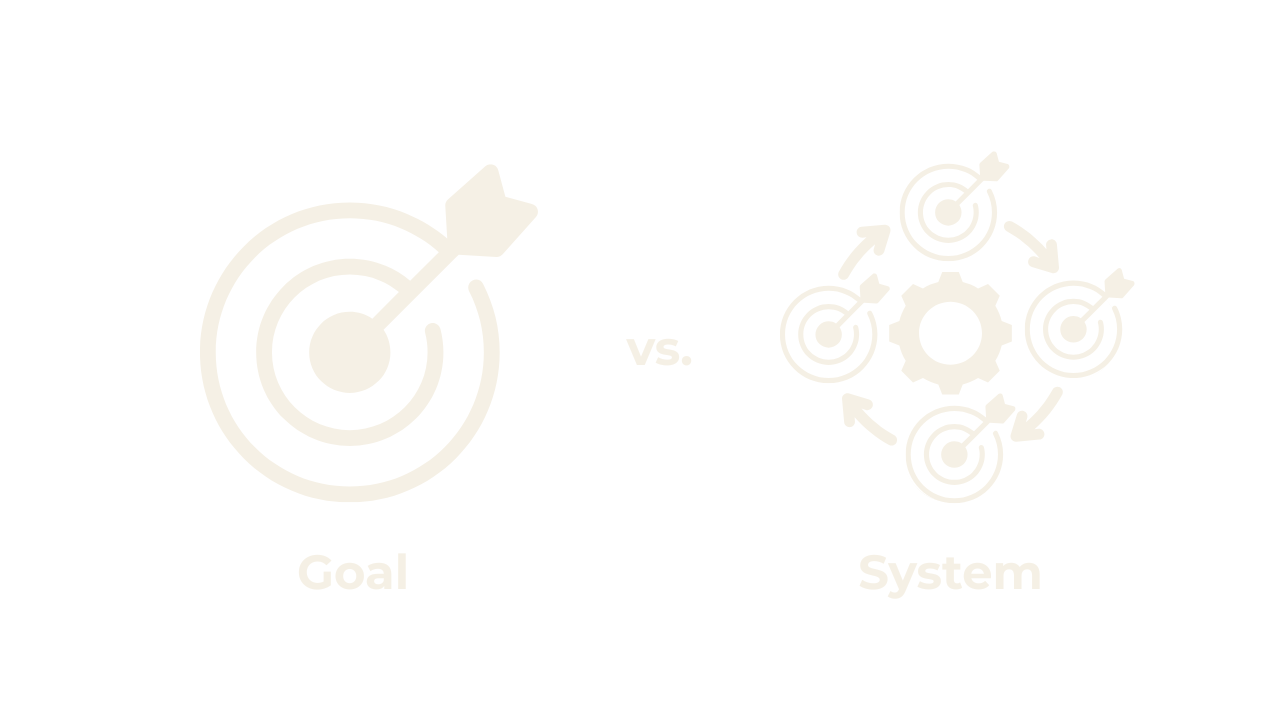
I used to plan wrong.
I wrote goals. Revenue targets. Product launches.
Then I was surprised why March looked nothing like my plan.
Here's what I missed:
I don't rise to my goals—I fall to my systems.
The Truth About Goals vs. Systems
For years at ForkOn, our goal-setting looked like this:
"What revenue do we need to show growth to our investors?"
"Based on our vision, which SMART goals should we target?"
We'd build financial plans based on assumptions that sounded great. Realistic. Coherent.
Sometimes investors wanted more growth. So we'd increase the projections by a few percentage points. Still sounded great. Still realistic.
Never once—not in a single year—did we execute on these goals.
The problem wasn't the goals themselves. You need moonshot goals in a startup context.
The problem was we weren't building the right systems.
We thought, "To double revenue, we simply need to double the sales team."
Or: "To double software output, we need to double the developers."
Linear thinking. More input = more output.
That's not how it works.
When Everything Changed
Everything shifted when all three of my co-founders quit simultaneously.
I had 90 days to turn a sinking ship around. The company was valued at €16M, but we were running out of cash. I had to show significant revenue growth, or we'd be done.
I couldn't hire my way out of this. In fact, I had to cut personnel costs by 35% that same year.
So I stopped thinking about goals and started thinking about systems.
I developed what I now call the 2-Hour Hyperfocus System and executed it daily. Every single day.
I rebuilt our entire sales system from scratch:
- How we generate leads
- How we convert them into prospects
- How we close them into new customers
The results after 6 months:
- Sales cycle from 11 months to 3 months
- Close rate from 4% to 17%
- Revenue growth that year: 300%
Without hiring new salespeople.
What I Learned The Hard Way
Setting goals is great. But without building the right systems, your goals stay wishes.
Because you don't rise to your goals, but you fall to your systems. Especially when things go south.
The best part: Once the right system is established, it becomes the foundation for future scale. You're already working today on achieving tomorrow's goals.
With this mindset, it's even possible to outperform your SMART goals.
This Week's Action:
Instead of just writing down 2026 goals, use this protocol to build the system that will get you there:
DAY 1: Find Your Real Bottleneck (10 minutes)
Answer these two questions honestly:
Question 1:
→ This reveals what you're emotionally resisting because it causes short-term pain.
Question 2:
→ This forces you to ignore shiny objects—the things that feel like productivity but are really distractions.
Your bottleneck is at the intersection of these two answers.
DAY 2: Execute Your First 2-Hour Hyperfocus Block
Step 1: Brain Dump (5 min)
Write down everything in your head. All tasks, worries, ideas. Get it out.
Step 2: Eisenhower Sort (5 min)
Go through your list: → Delegate what others can do → Schedule what's not urgent → Delete what doesn't matter → Keep ONLY what's important AND urgent
Step 3: Hyperfocus Protocol (2 hours)
Work on your bottleneck in four 25-minute blocks:
Block 1 (25 min) → Start solving the bottleneck, Break (5 min) → Stand, water, breathe
Block 2 (25 min) → Continue, Break (5 min) → Stand, water, breathe
Block 3 (25 min) → Continue, Break (5 min) → Stand, water, breathe
Block 4 (25 min) → Finish strong
Rules during blocks:
- No phone
- No email
- No Slack
- No meetings
- Just you and the one problem
DAY 3-7: Repeat Daily
Block 2 hours every morning in your calendar for January.
Same time. Non-negotiable.
By February 1st:
40+ focused hours on your bottleneck = More progress than most founders make in 6 months.
That's it for this week.
If you want help identifying your bottleneck and building your focus system, I created a Crisis Survival Kit. It's the exact framework I used to rescue ForkOn—including templates for time audits, bottleneck identification, and the 2-hour focus protocol.
Reply "yes" if you want this.
Good luck and a happy new year!
🌱 Tim
Author